




































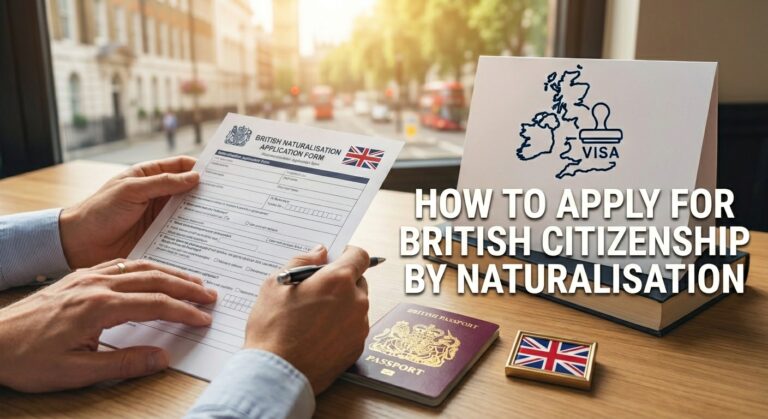
Becoming a British citizen is the final step in most people’s immigration journey in the UK. It gives you the right to a British passport, the right to vote, and the freedom to live and work in the UK permanently without any immigration condition attached to your stay. This guide explains the eligibility requirements, the application process, current fees, and what to expect after you apply in 2026.
What is naturalisation?
Naturalisation is the legal process under Section 6 of the British Nationality Act 1981 by which an adult foreign national acquires British citizenship. It is distinct from registration, which applies to certain children and those with a connection to Britain through ancestry or previous British status.
Once granted, you receive a Certificate of Naturalisation at a citizenship ceremony. Only after attending the ceremony can you apply for a British passport. The ceremony is a legal requirement — citizenship is not complete until it has taken place.
Who can apply?
To apply for naturalisation you must be aged 18 or over and meet all of the following requirements.
Residence requirement
There are two residence thresholds depending on whether you are married to a British citizen.
If you are married to or in a civil partnership with a British citizen, you must have been lawfully resident in the UK for at least three years immediately before the application date, with no more than 270 days absent in that three-year period and no more than 90 days absent in the final 12 months.
If you are not married to a British citizen, you must have been lawfully resident in the UK for at least five years immediately before the application date, with no more than 450 days absent in the five-year period and no more than 90 days absent in the final 12 months.
ILR or Settled Status
You must hold Indefinite Leave to Remain or EU Settled Status at the time of applying. EUSS Settled Status is treated as equivalent to ILR for naturalisation purposes.
If you are married to a British citizen, you can apply for naturalisation as soon as you hold ILR — you do not need to wait 12 months. If you are not married to a British citizen, you must hold ILR for at least 12 months before applying.
Good character
You must satisfy the good character requirement. This covers criminal record, immigration compliance history, tax compliance, and honesty in your dealings with the Home Office. Spent convictions can still be relevant depending on their nature and recency. Every declaration must be accurate — misrepresentation is treated far more seriously than the underlying issue in almost all cases.
Life in the UK test
You must have passed the Life in the UK Test. The test costs £50 per attempt and is booked through the official gov.uk website. If you have already passed it for an earlier immigration application such as your ILR, the same certificate is used — it does not expire once passed.
English language
You must demonstrate English language ability at CEFR B1 level or above. If you evidenced B1 for your ILR or FLR(M) application using a SELT certificate, the same certificate can generally be used for naturalisation — provided it has not expired. SELT certificates are typically valid for two years from the test date. Nationals of majority English-speaking countries, and those with a degree taught entirely in English, are exempt.
Intention to remain in the UK
You must intend to continue living in the UK after citizenship is granted. This is a declaration made on the application form. It does not prevent you from subsequently living abroad, but it must be genuine at the time of application.
Two referees
Naturalisation applications require two referees. One must be a professional person — a solicitor, teacher, accountant, doctor, or similar. The second must be a British citizen aged over 25. Both must have known you personally for at least three years, must not be related to you, must not live at the same address as you, and must not work for the Home Office. Referee details are checked and errors or inconsistencies here can delay an application.
The application process
The naturalisation application — Form AN — is submitted online through the UKVI portal. Once submitted, you book an appointment at a UKVCAS centre to provide biometrics. The application is then processed by the Home Office.
Unlike most visa and settlement applications, there is no priority or super-priority service for naturalisation. You cannot pay an additional fee to receive a faster decision. The Home Office aims to process most straightforward naturalisation applications within six months, though some applications — particularly those involving complex residence histories, good character concerns, or additional security checks — take considerably longer.
If your application is approved, you receive an invitation to a citizenship ceremony at your local council. Ceremonies typically take place within three months of the approval decision. You must attend the ceremony and take the oath or affirmation of allegiance before your Certificate of Naturalisation is issued. Only once you hold the certificate can you apply for a British passport.
Fees in 2026
The adult naturalisation application fee is £1,605. A separate citizenship ceremony fee of £130 is payable on approval — bringing the total cost to £1,735. Both fees are non-refundable if the application is refused, with the limited exception that if an application is rejected as invalid before processing, the fee may be refunded less a £30 administration charge.
Additional costs include the Life in the UK test at £50 per attempt, any English language test if required, and certified translations of any supporting documents not in English. These are charged separately by the test provider or translator.
After citizenship is granted
Once you have attended your citizenship ceremony and received your Certificate of Naturalisation, you can apply for a British passport. Adult passport applications cost £88.50 online and £100 by post. Standard processing is typically around 10 working days for online applications.
As a British citizen you have the right to live and work in the UK permanently, the right to vote in all UK elections, and a British passport that gives you visa-free or visa-on-arrival access to over 180 countries worldwide.
Can I keep my existing nationality?
The UK permits dual nationality — you do not need to renounce your current citizenship when you become a British citizen. However, whether you can actually hold both nationalities depends on the laws of your other country. Some countries — including India, China, and Japan — do not permit their nationals to hold dual nationality, and becoming a British citizen may cause you to automatically lose your original citizenship. Check the rules of your country of origin before applying if retaining your existing nationality is important to you.
Frequently asked questions
How long does a British citizenship application take in 2026?
The Home Office aims to process most naturalisation applications within six months. There is no priority service — you cannot pay for a faster decision. Some applications take longer where there are complex residence histories, good character issues, or additional security checks required.
Can I apply for British citizenship straight after getting ILR?
If you are married to a British citizen and meet the residence requirements, yes — you can apply immediately upon receiving ILR without waiting 12 months. If you are not married to a British citizen, you must hold ILR for at least 12 months before applying.
What are the fees for British citizenship by naturalisation in 2026?
The application fee is £1,605. A citizenship ceremony fee of £130 is payable on approval, bringing the total to £1,735. These fees are non-refundable if the application is refused. Additional costs include the Life in the UK test (£50), any required English language test, and certified translations.
Do I need to give up my current nationality to become British?
Not from the UK’s perspective — the UK permits dual nationality. However, your country of origin may not. Countries including India, China, and Japan generally do not permit their nationals to hold dual citizenship. Check the rules of your other country before applying if this matters to you.
What happens at a citizenship ceremony?
You attend a ceremony at your local council where you take an oath or affirmation of allegiance to the Crown and a pledge to the United Kingdom. You then receive your Certificate of Naturalisation. The ceremony is a legal requirement — you cannot receive your certificate or apply for a British passport without attending.
JPS Immigration advises on and manages British citizenship applications from start to finish, including eligibility checks, referee guidance, and application preparation. Call +44 (0) 333 577 0034 or visit jpsimmigration.com/assessment for a free initial assessment.