




































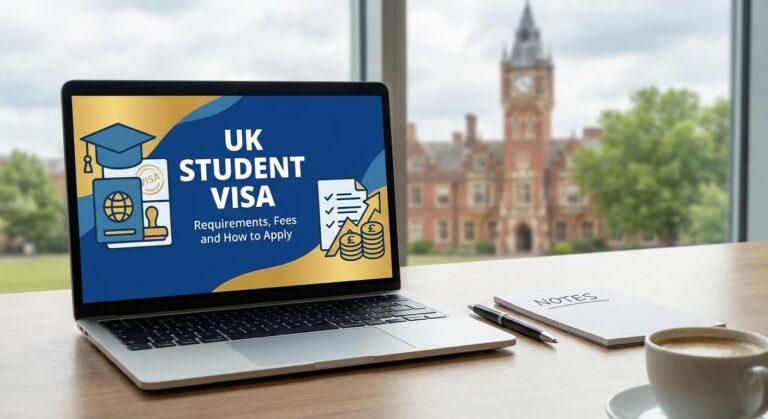
The UK is home to some of the world’s leading universities and attracts hundreds of thousands of international students every year. To study in the UK for more than six months, you need a Student Visa — formally known as the Student Route. This guide covers every requirement for 2026, including changes that took effect on 8 January 2026, the financial evidence rules, fees, work rights, and what your options are after you graduate.
What is the UK Student Visa?
The UK Student Visa replaced the Tier 4 (General) student visa in October 2020. It allows international students aged 16 or over to study full-time at a UK institution that holds a valid student sponsor licence. The visa is not simply a study permission — it also determines how long you can remain in the UK, what work you can do, and whether you can bring family members with you.
Successful applicants now receive a digital eVisa linked to a UKVI online account rather than a physical Biometric Residence Permit. You prove your immigration status using a share code generated through the UKVI online service.
Core eligibility requirements
A Confirmation of Acceptance for Studies (CAS)
The starting point for every Student Visa application is a CAS — a unique digital reference number issued by your university or college confirming that they have offered you a place on a specific course. You cannot apply for a Student Visa without a CAS. The CAS number is entered into your online application and links your visa application to your course details, fees, and sponsor.
Your CAS is valid for six months from the date it is issued. You can apply for your Student Visa up to six months before your course start date if applying from outside the UK, or up to three months before if applying from within the UK.
Confirm that your institution holds a valid student sponsor licence before applying — institutions can lose their licence without notice, and if your sponsor is not licensed when your application is decided, your visa will be refused.
Financial requirement — the 28-day rule
You must demonstrate that you have sufficient funds to cover both your course fees and your living costs. The financial requirement has two parts.
For course fees, you must show you can pay the first year’s tuition fees — or the full fees if the course is less than a year. The exact amount will be stated on your CAS.
For living costs, the required amounts are set by the Home Office and depend on where you will be studying:
- Studying in London: £1,529 per month for up to 9 months
- Studying outside London: £1,171 per month for up to 9 months
These funds must have been held continuously in your bank account for at least 28 consecutive days immediately before you apply. The closing date of the 28-day period must be no more than 31 days before the date you submit your application.
This is the most common reason Student Visa applications are refused. Funds that dip below the required level on even a single day within the 28-day window can result in refusal. Do not make large withdrawals, transfers, or payments during this period. Ensure the statements are dated correctly and cover the full 28-day window.
English language requirement — B2 from January 2026
From 8 January 2026, the English language requirement for new Student Visa applicants increased from CEFR B1 to CEFR B2. This is a meaningful increase — B2 represents upper-intermediate proficiency.
The requirement must be evidenced through a Home Office-approved Secure English Language Test (SELT). The most commonly used test is IELTS for UKVI — note that this is a specific version of IELTS for immigration purposes and is different from the standard IELTS Academic test used for university admissions. Using the wrong test version is a common and entirely avoidable refusal reason. Always verify that your chosen test and provider are on the current Home Office approved list before booking.
Exemptions apply for nationals of majority English-speaking countries, those who have previously completed a degree-level qualification taught entirely in English, and applicants whose university confirms English proficiency through other means.
Genuine student requirement
The Home Office assesses whether you are a genuine student with a credible reason for studying your chosen course at your chosen institution. Caseworkers look for a logical connection between your academic background, your course choice, and your plans after graduation. If there are inconsistencies — for example, a significant change of academic direction without explanation — you may be asked to attend an interview, or your application may be refused on credibility grounds.
Dependants
The rules on bringing dependants have been significantly restricted. As of 2024, only the following students can bring a partner or children to the UK:
- Students on a PhD or other doctoral qualification at a higher education provider with a track record of compliance, where the course lasts at least 9 months
- Students who have a government or government-sponsored scholarship covering the full course
Undergraduate students and taught postgraduate (master’s) students cannot bring dependants to the UK under the Student Route. This is one of the most significant changes of recent years and must be factored into your planning if you have a family.
Work rights
Most degree-level students can work up to 20 hours per week during term time and full-time during official university vacation periods. Some further education students are limited to 10 hours per week during term time. You cannot be self-employed or work as a professional sportsperson on a Student Visa. The specific work conditions attached to your visa will be confirmed in your visa grant letter.
Fees in 2026
The Student Visa application fee from 8 April 2026 is £558 — whether applying from outside the UK or extending from within the UK. You also pay the Immigration Health Surcharge at a discounted student rate of £776 per year upfront for the full duration of your visa.
For a three-year undergraduate degree, the total IHS payment is £2,328. This is paid at the time of application and cannot be paid in instalments.
Processing times
Standard processing for Student Visa applications made from outside the UK is approximately 3 weeks from the biometrics appointment. For in-country applications and extensions, standard processing is up to 8 weeks. Processing times are longer during peak months — particularly June to September, ahead of the main September intake. Apply as early as possible.
A priority service targeting 5 working days and a super-priority service targeting the next working day are available at additional cost of £500 and £1,000 respectively, subject to availability at your local visa application centre.
What happens after you graduate — the Graduate Visa
After completing your course, you can apply for the Graduate Visa, which allows you to live and work in the UK without needing employer sponsorship. The duration of the Graduate Visa depends on when you apply:
- 2 years — for bachelor’s and master’s graduates who apply on or before 31 December 2026
- 18 months — for bachelor’s and master’s graduates who apply on or after 1 January 2027
- 3 years — for PhD and doctoral graduates, regardless of application date
The Graduate Visa cannot be extended. Many graduates use it to find employment and then transition to a Skilled Worker Visa for long-term residence. The reduction in the Graduate Visa duration from January 2027 makes early career planning increasingly important — if you are due to graduate in 2026 or 2027, factor this into your decisions. See our UK Skilled Worker Visa 2026 guide for detail on what comes next.
The Graduate Visa application fee is £880, plus the IHS if applicable.
ATAS — Academic Technology Approval Scheme
If you are studying certain sensitive subjects at master’s level or above — particularly in engineering, science, and technology — you may need an Academic Technology Approval Scheme (ATAS) certificate before applying for your Student Visa. Your university will advise whether your course requires ATAS. Processing an ATAS application can take several weeks, so apply for it early if required.
TB test
If you are applying from a country on the Home Office list of countries where a tuberculosis test is required, you must provide a TB test certificate from an approved clinic. Check the current list on gov.uk before applying.
Frequently asked questions
What is the English language requirement for a UK Student Visa in 2026?
From 8 January 2026, the requirement increased to CEFR B2. This must be evidenced through a Home Office-approved Secure English Language Test — most commonly IELTS for UKVI. Note that the standard IELTS Academic test is not accepted for visa purposes — you must book the UKVI-specific version at an approved centre.
How much money do I need to show for a UK Student Visa?
You need to show your first year’s tuition fees plus living costs of £1,529 per month (in London) or £1,171 per month (outside London) for up to 9 months. These funds must have been in your account continuously for at least 28 days before you apply, and the closing date of that 28-day period must be within 31 days of your application date.
Can I bring my family on a UK Student Visa?
Only if you are a PhD or doctoral student at an eligible institution on a course lasting at least 9 months, or if you hold a government or government-sponsored scholarship. Undergraduate and taught postgraduate students cannot bring dependants to the UK under the Student Route.
How long does a UK Student Visa take to process?
Approximately 3 weeks from the biometrics appointment if applying from outside the UK, and up to 8 weeks for in-country applications. Processing is slower during peak periods from June to September. Apply as early as possible — up to 6 months before your course start date if applying from abroad.
What can I do after my Student Visa ends?
You can apply for the Graduate Visa to remain in the UK without a job offer — valid for 2 years (bachelor’s/master’s graduates applying by 31 December 2026) or 18 months (from January 2027), or 3 years for PhD graduates. Many students then switch to a Skilled Worker Visa once they secure graduate-level employment.
JPS Immigration advises students and their families on Student Visa applications, extensions, and the transition to work visas after graduation. Call +44 (0) 333 577 0034 or visit jpsimmigration.com/assessment for a free initial assessment.